

Vínculos y diferencias con el VJing
En resumen
Mientras que el VJing se centra en mezclar y reproducir contenido de vídeo en tiempo real, el «video mapping» es la tecnología que se utiliza para dar forma y proyectar imágenes sobre superficies tridimensionales. A menudo, ambas técnicas se combinan en los espectáculos en directo, donde programas fáciles de usar como HeavyM permiten a los VJ adaptar fácilmente sus mezclas a diseños de escenarios complejos.
¿Qué es un VJ?
En el mundo del espectáculo en directo, el término ‘VJ’ significa ‘Video Jockey’,’ un artista que crea y manipula imágenes en tiempo real para acompañar la música o el sonido en eventos en directo. Al igual que un DJ (disc jockey) que mezcla música, Un VJ mezcla imágenes para crear una experiencia audiovisual inmersiva para el público.
Los VJ utilizan diversas tecnologías y técnicas, incluida la proyección de vídeo, video mapping, animación en tiempo real y mucho más. Trabajan en diversos entornos, como conciertos, festivales, discotecas e incluso eventos corporativos.
La esencia del VJing es el fusión de arte y tecnología, y es precisamente esta combinación la que permite a los VJ transformar un espacio escénico en un mundo visualmente cautivador.
El surgimiento del VJing
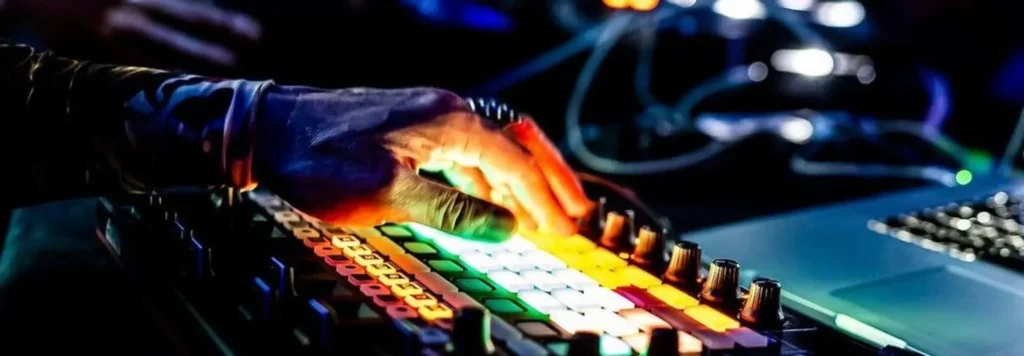
Los primeros VJ, tal y como los conocemos hoy en día, surgieron a principios de la década de 1980. Merrill Aldighieri, artista multimedia y cineasta, Se la suele considerar la primera VJ. En mayo de 1980, fue invitada a proyectar una película en el ¡Hurra! discoteca.
En aquella época, no había muchos vídeos musicales y, de vez en cuando, se utilizaban instalaciones de vídeo para proyectar películas. Para elevar los elementos visuales al mismo nivel que la música del DJ, Merrill creó una amplia colección de imágenes ambientales que se pudieran combinar en tiempo real para interpretar la música.
Trabajar junto al DJ, esta recopilación de imágenes sin procesar fue mezclado en tiempo real para crear una interpretación visual ininterrumpida de la música. Los fundadores de MTV visité este club, y Merrill Les dio a conocer el término y la función del VJ, lo que les animó a contar con presentadores VJ en su canal al año siguiente.
¿Qué relación tiene esto con el video mapping?
VJing y video mapping son dos técnicas distintas en la creación y la ejecución de las artes visuales, pero a menudo son utilizados conjuntamente.
El VJing, como se ha mencionado anteriormente, se refiere a la práctica que consiste en mezclar y manipular imágenes de vídeo en tiempo real, normalmente en sincronización con la música durante los eventos en directo. Un VJ (Video Jockey) es el artista que lleva a cabo estas acciones, utilizando software y hardware específicos para crear y controlar los efectos visuales.
El video mapping, por su parte, es una técnica específica que consiste en proyectar vídeos sobre superficies tridimensionales, a menudo edificios u otras estructuras escénicas. El Las imágenes se adaptan cuidadosamente a la forma de la superficie para crear la ilusión que las imágenes forman parte, de hecho, de la propia estructura. Esto puede dar lugar a efectos visuales impresionantes, como la transformación aparente de la estructura o la creación de escenas visuales complejas e historias.
Si bien el VJing se centra más en la manipulación de imágenes en tiempo real, El video mapping requiere una planificación y una preparación más detalladas para ajustar con precisión las imágenes a la superficie de proyección. Sin embargo, Las dos técnicas se pueden utilizar conjuntamente; por ejemplo, un VJ podría utilizar el video mapping durante una actuación para proyectar sus creaciones sobre una estructura o un edificio.
Para continuar
Primeros pasos: presupuesto y equipamiento
Esta guía ha sido redactada por HeavyM, una empresa especializada en video mapping desde 2013.
Si tienes alguna pregunta, comentario, sugerencia, etc., utiliza este formulario de contacto: https://help.heavym.net/hc/requests/new. Respuesta garantizada en un plazo de 24 horas.
Preguntas más frecuentes (FAQ)
¿Cuál es la principal diferencia entre el VJing y el video mapping?
El VJing es el arte de mezclar, manipular y reproducir contenido de vídeo en directo, sincronizado con la música. El «video mapping», por su parte, es el proceso técnico que consiste en deformar y adaptar la luz proyectada a estructuras físicas y superficies no planas, en lugar de a pantallas estándar.
¿Puedo utilizar software VJ para el video mapping?
Muchas herramientas avanzadas de VJ (como Resolume) incluyen funciones básicas de mapping por secciones. Sin embargo, para configuraciones estructurales complejas, video mapping software específico como HeavyM resulta mucho más rápido y fácil de usar, ya que permite dibujar formas y aplicar efectos visuales integrados directamente sobre objetos físicos.
¿Es HeavyM adecuado para actuaciones de VJ en vivo?
Sí. HeavyM cuenta con un generador integrado de efectos visuales interactivos que se sincronizan automáticamente con la música en directo, lo que lo convierte en una herramienta excelente para los VJ que desean centrarse en su espectáculo creativo sin tener que dedicar horas a programar.